How Quit Smoking Apps Improve Quit Rates and Daily Consistency
Digital Tools8 min

A quit smoking app does not replace willpower. It replaces the bits of quitting that willpower is bad at: noticing patterns, remembering plans under pressure, and turning effort into visible evidence.
That distinction matters because the willpower model leaves out the part of quitting that actually moves the dial. Two weeks before quit day, more than a third of adults preparing to stop could not name a single behaviour change they were going to make.PMC Most quit attempts collapse there, not in the moment of the craving. An app's real job is to fill in that gap before quit day arrives, and to keep filling it once it has.
This guide is about the mechanism: what an app is actually doing for you when it does its job well, and how to tell when it isn't. If you have already decided to use one and want to choose between them, the companion guide to choosing a quit smoking app is the place to start.
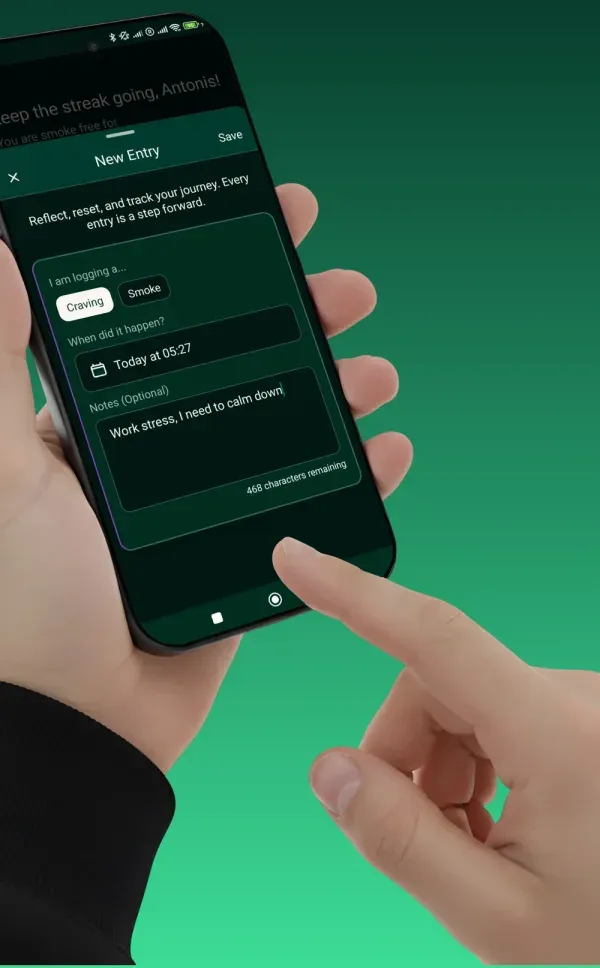
Quit It is built around the four jobs an app needs to do well: noticing patterns, prompting before cravings peak, turning small wins into visible evidence, and keeping the plan close at hand when willpower wobbles.
What an App Is Actually Doing For You
Most people pick a quit app for its streak counter. That's the visible bit. The useful bit is quieter.
A well-designed quit app is doing four things at once.
It collects the data you can't keep in your head. Time of day, mood, situation, whether you smoked or rode the craving out. After a week, the blur called "I smoke" turns into a small handful of repeating shapes you can actually plan around. This is how willpower gets out of having to remember things.
It puts a plan within reach at the wrong moment. A craving is the worst time to think. The app holds your if-then plan, your breathing exercise, your reasons, your savings number, your last logged win, so you don't have to reconstruct any of it under pressure.
It builds evidence of capability, not just abstinence. Each craving you logged and rode out is concrete proof that you can do this, and your own track record of having done the thing is the strongest source of the belief that you'll keep doing it.SAGE A good app makes that record visible enough to count.
It gives you a reason to come back tomorrow. Across the financial-incentive research, the cash itself isn't doing the heavy lifting;Springer the recognition does, and the reason to show up does. Streaks, milestones, and saved-money totals are doing the same job at a fraction of the cost.
A streak is a thin slice of the last point. It works because the other three are working underneath it.
Awareness Comes Before Willpower
Most people try to quit before they understand the shape of their own habit. That's the order that fails.
Smoking lives on autopilot. You aren't standing outside in the cold every morning because you want to be. You're there because, for years, the morning coffee handed off to the cigarette without anyone consulting you. Common smoking triggers fall into a small set of repeating shapes:NCI routine cues, emotional cues, social cues. You almost certainly have a top two. You probably don't know which.
Tracking is how you find out. The mechanism is mundane: log each cigarette with a one-tap note for context, and after a few days the pattern becomes obvious. The cigarette you would have sworn was about stress turns out to be about the walk to the car. The one you blamed on a colleague was actually about the gap between meetings. The app's job here is to make it cheap enough to log that you actually do it.
Environment matters more than people realise. Brief exposure to images of smoking environments measurably shortens how long someone can hold off lighting up,PMC even with money on the line for waiting. The cue is moving you before the craving registers consciously. You can only redesign environments you've named, and you can only name them by logging them.
This is also why tracking is the part of quitting people most often say they wish they'd started sooner. The information is what the plan rests on.
Small Wins Are How Confidence Is Built
People expect confidence to arrive after a clean week. It doesn't work like that. Confidence is built one earned moment at a time, and the moments only count if you can see them.
Each craving you sit through teaches your brain two things. The cue doesn't lead anywhere, so its pull genuinely weakens with practice.PMC And you, the person who just sat through it, are someone who can. Repeated success is the most reliable predictor of long-term abstinence,SAGE more so than how much you wanted to quit on day one.
The problem is that small wins are easy to discount in real time. A craving that passed in seven minutes feels like nothing. A weekend without a cigarette feels like a Sunday afternoon, not a milestone. An app's most underrated job is to refuse to let those count as nothing.
The badge or the level isn't doing the work. The visibility is. Apps that pair education and motivation with gamified milestones help people stay smoke-free more often than plain trackers,PMC and they also produce stronger self-belief and engagement. Those aren't separate effects from the abstinence one. They are how the abstinence happens. The same idea sits behind identity-based quitting: every visible win quietly reinforces who you're becoming.
Combining the App With NRT (or Medication)
Apps are a behavioural tool. They sit alongside the pharmacological side of quitting, not in place of it. That separation matters because the strongest cessation outcomes come from doing both.
Combining behavioural support with cessation medication is more effective, and more cost-effective, than either on its own.LWW UK national guidance is unambiguous about this:NICE the standard for adults trying to quit is a structured behavioural component paired with NRT, varenicline, or cytisinicline. An app is one practical, scalable way to deliver the behavioural half, especially when in-person counselling isn't available.
NRT handles the chemistry. The app handles the habit. The two layers don't compete with each other. The comparison piece is here if you want to think through which forms of NRT match which patterns.
What the Numbers Make Real
There's a category of motivation that doesn't really exist until it's visible.
Saving money is the obvious one. Almost every smoker knows it's expensive. Almost no one carries the exact number in their head. Watching a saved-money total climb past concrete things you'd want to buy does something the abstract knowledge doesn't. It turns the cigarettes you aren't smoking into something you're getting, rather than something you're giving up.
Health gains work the same way. The 24-hour drop in carbon monoxide, the 2-week improvement in circulation, the year-mark on cardiovascular risk: these are real, well-documented physical recoveries that most people forget within a day of reading about them. An app that surfaces them at the right moments turns vague benefits into milestones you can feel.
Cravings resisted, smokes skipped, and smoke-free time fall into the same family. Effort that isn't seen tends to fade. Effort that's named keeps building. Positive reinforcement is one of the quieter mechanisms behind a quit that holds, and it only works if the wins are surfaced often enough to register.
Where Apps Stop Helping
Be honest about what an app can't do.
An app can't make a craving disappear. Cravings are a physiological signalPMC generated by your brain recalibrating off nicotine. The app can hand you a tool to ride one out: a breathing exercise, a logged distraction, a sentence to read. It can't turn one off.
An app can't replace social support. People with someone in their corner during a quit attempt are about as motivated to try again as people who used a formal programme, and that holds across age groups, sexes, and levels of nicotine dependence.PMC The app's job is to make support easier to ask for, not to be the support itself.
An app can't quit for you. Tools work alongside intention. The decision is still yours. If the app starts feeling like a critic instead of a coach, switch the framing or switch the app. Quitting is hard enough without a tool that makes you feel watched.
Late cravings still happen,PMC sometimes years after the last cigarette. A logged craving five years in is not a relapse, it's an entry. The frame holds because the frame is yours.
How To Pick One You'll Actually Keep Using
A few practical filters, kept short here because the full buyer's-guide depth lives in that companion piece.
Logging needs to be one tap. If logging a craving feels like writing an email, you'll skip it on the days that matter most. The data is only useful if it accumulates.
You need to see your wins. Streaks, savings, cravings resisted, smoke-free hours. Whatever the surface, the test is whether you finish a session feeling like the work was acknowledged.
The plan needs to be reachable in three seconds. Your if-then plan, your reasons for quitting, your contact for the bad days. If you have to dig for it, you won't use it when you need it.
The tone needs to fit you. Some people thrive on a coach voice, others on data, others on quiet encouragement. The right fit is the one you'll still open in week six.
It should support the long arc, not just day one. UK guidance treats quitting as a chronic condition with a dedicated relapse-prevention layer,NICE not a single event. The app should still feel useful in month three, when the hard part is showing up to something quiet.
FAQ
Do quit-smoking apps actually work?
Yes, with the caveat that the active ingredient is what they help you do, not the app itself. Apps combining education, motivation, social features, and gamification help people stay smoke-free more often than non-gamified apps,PMC and they also produce stronger self-belief and engagement, which is what predicts whether you stay quit long-term.
Should I use an app alone or with NRT?
Both, if your situation supports it. UK guidance recommends behavioural support combined with NRT, varenicline, or cytisiniclineNICE as the standard for adults trying to quit. An app is a practical way to deliver the behavioural side.
How long until tracking starts paying off?
Most people see useful patterns within five to seven days. The first day or two of logging tends to make smoking feel more present, then attention shifts the other way as each entry closes a small loop your brain was holding open.
Why is logging a slip better than starting over?
Because a slip is information about which context your plan doesn't yet cover, and starting over throws that information away along with every win you'd banked. Logged, it becomes some of the most useful data in the whole record; unlogged, it turns into shame and forgetting. That is the difference between a tracked slip that turns into a better plan and a reset that just resets the feeling of failure.
Will an app be enough if I'm a heavy smoker?
By itself, often no. The strongest cessation outcomes come from combining behavioural support with pharmacotherapy (NICE NG209,NICE behavioural modification review).LWW Treat the app as one half of a two-part plan.