Feature walkthrough
Milestones & First Days
From the first 20 minutes through years of falling risk, follow the recovery timeline your body is already on, and use guided actions when the early days need a next step.


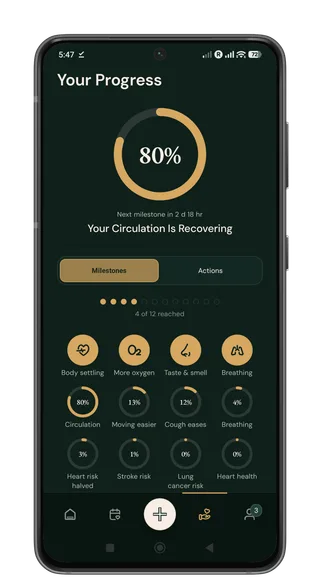
Recovery begins before you notice it. Within 20 minutes of your last cigarette, heart rate starts moving back toward baseline. Within 12 hours, carbon monoxide in the blood drops toward a healthier range. By 48 hours, smell and taste often start returning: for many people, the first physical proof that quitting is doing something.
Quit It keeps that timeline in front of you as the weeks unfold: circulation and oxygen, easier breathing, lung function gains across the first months, and longer marks like heart disease risk roughly halved by one year. When looking ahead is not enough on its own, switch to Actions for guided steps through the first days, when withdrawal peaks and the repair work is still mostly invisible.
How This Helps
- Follow the familiar recovery timeline from the first hours through months and years of falling risk.
- See what is already underway, circulation, taste and smell, breathing, and what still sits ahead.
- Use guided actions in the early days when withdrawal is loud and the body repair is hard to feel.
Practical Tips
- Open the timeline when the first week feels like nothing is improving. Withdrawal and recovery happen at the same time.
- Treat early sensory shifts, like taste and smell returning around 48 hours, as real proof, even if cravings are still strong.
- If the early days feel empty, switch to Actions and pick one task. The first week needs something to do with the hours that used to end in a cigarette.
When It Helps Most
In the first days and weeks especially, and whenever progress feels hard to trust because the repair is still mostly internal.
- The known recovery timeline, from 20 minutes onward
- Milestones for circulation, breathing, taste, and risk reduction
- Next milestone countdown as smoke-free time grows
- Guided actions for the first days
Your next smoke-free choice starts here.
Set up your reason, track what actually happens, and let every small win count toward a cleaner pattern.